ADASS President Phil Holmes opens NCASC 26 with rallying call for adult social care reform: “It’s time to roll up our sleeves”
On this page
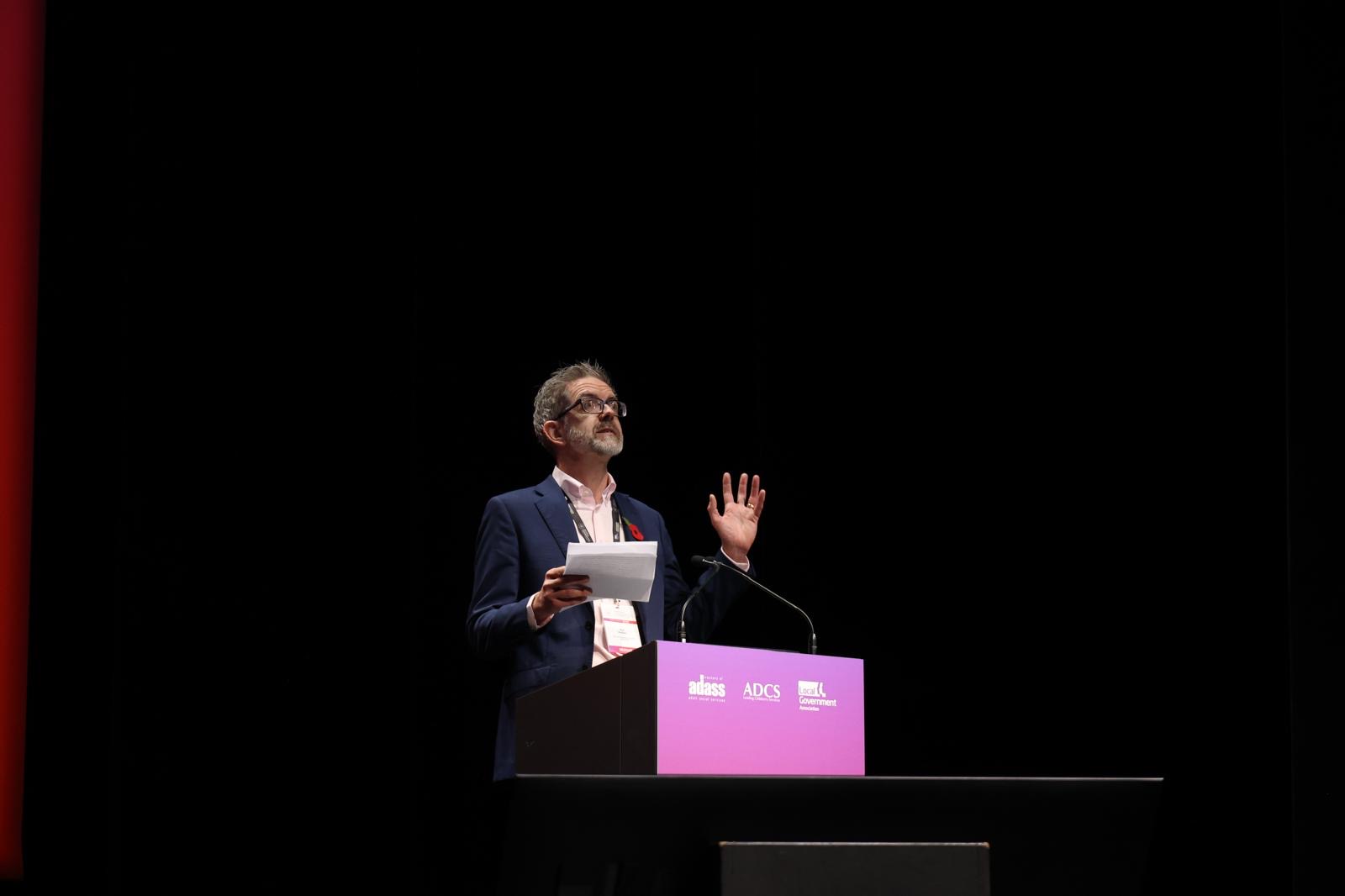
Another slow news day in adult social care. I’d never have put myself forward to be ADASS President if I had known it was going to be such a quiet year. That Louise Casey wouldn’t say boo to a goose.
No, seriously, it’s an exhilarating time. I started my presidential term buoyed by Louise’s commitment to move beyond sticking plaster solutions. Two Secretaries of State for Health and Social Care later, we were hearing the Prime Minister personally commit to adult social care reform, describing the skill and humanity of our workforce, saying “we are going to do this” and acknowledging the political capital required to get traction on an issue that our society has been in denial about for decades.
It is exhilarating but there’s so much to get on top of. When people ask what it’s like being ADASS President during such a critical period I often reply it feels like an emotional rollercoaster. Exhilaration, yes, but disorientation too.
Of course adult social care is fundamentally disorientating – if it wasn’t we wouldn’t need to reform it. Paul Adams played cricket for South Africa in the mid-1990s. Bear with me. Every time he ran up to bowl his whole body seemed to involuntarily contort in all directions at once before his arm shot out at an impossible-looking angle to launch the ball. A pundit at the time said he looked like a frog in a blender and that’s adult social care that is. Whether you are seeking support from adult social care or you work in it, you will spend lots of time being yanked around every which way while you try to reach out and land something that will make the right impact on your own life or the lives of others.
Although he resembled a frog in a blender Paul Adams was a surprisingly effective bowler. The ball very often landed in the right place. We can also see adult social care in this way – in spite of the ludicrous distorting forces they are dealing with, many skilled and committed people rise above the nonsense every single day to make the right things happen.
Things always feel better when the blender is turned down a notch, like when the Home Secretary reconsidered her position on the rights of international care workers last week. But how great it would be if we didn’t experience the senseless churn at all, if we saw everything moving in the same direction, better lives for people who need care, better lives for unpaid carers, better reward and satisfaction for our workforce, better value for the public purse?
Ultimately the challenge for policy makers is to make it all make sense but if the underlying state of adult social care is disorientating, the experience of change can be confusing too. What’s that you say? Can you have another sporting metaphor to illustrate this? Well okay. Jim Furyk is an American golfer whose convoluted and awkward swing was once likened to an octopus falling out of a tree. Public service reform feels like an octopus at the moment doesn’t it? Octopuses are miraculous creatures with a big brain and a strong sense of coherent design. Flipping heck they don’t half have a lot of arms though. Admittedly every arm makes sense and helpfully, if it’s put under too much stress, the octopus can chew an arm off and grow it back later. Take a bow Local Government Reorganisation.
But Jim Furyk’s golf swing isn’t just an octopus, it’s an octopus falling out of a tree. In other words, it’s one thing designing change and it’s another thing implementing it. Mixing metaphors is always a bad idea but I am a Director of Adult Social Services frog spinning in a blender plugged into a woodland somewhere, hearing a commotion above me, looking up to see a massive octopus rapidly descending, then feeling multiple policy arms all slapping me about at once.
Don’t let me be a hypocrite about this though. If I had been President of ADASS at almost any other time during the last ten years I would have been complaining about the absence of significant reform. It’s not a great look now for me to be moaning about there being too much all at once. And in the first speech I made when I picked up the Presidency I said that we in adult social care couldn’t just wait for Louise Casey to save us. I said we had to get out of the crouch position and having spoken to a fair few people since I think that struck a chord. So how can we get out of the crouch position and help the octopus to land well?
Twenty-one years ago just after I started in Derby as Head of Commissioning I did a one-day course on Polarity Management. I guess I must have had time on my hands. Polarity Management says don’t assume problems can be fixed with simple solutions, focus instead on managing relationships and trade-offs to make progress without getting stuck in conflict. It’s not rocket science but thanks all the same Derby City Council. Maybe the best way we can help the octopus land well is by showing humility, avoiding polarisation and being thoughtful about trade-offs.
Us Directors of Adult Social Services are currently worried about the idea of nationally standardising the way adult social care assesses the needs of individuals. Well, not the idea so much as how far it might be taken. Assessment is a great example of a problem that can’t be solved with a simple solution – unless you do only want a sticking plaster. On one pole, it’s clear that a locally labyrinthine system of assessment that people don’t understand and may actively fear, is not remotely desirable. Bureaucratic approaches to assessment also disproportionately pull social care colleagues into gatekeeping tasks and away from the therapeutic, connective and preventative role that motivated us to come into the profession in the first place.
On the other pole we have the viewpoint that we should turn adult social care assessment into a simple national prescription. This is fuelled by conversations with people up and down the country who have been so bewildered by the current system that they say “we just want to know what we are going to get”. The thinking arising from this might suggest a national system where points mean prizes, and the points you get means the same entitlement whether you live in Doncaster or Devon. I have heard colleagues representing care providers take this a step further. If we have a national approach for determining individual eligibility and providers who can respond to this why do we need local councils taking part in assessment and resource allocation at all?
That viewpoint assumes that assessment is the starting point for adult social care. First I am going to assess what you are entitled to, and then if you deserve anything it will be arranged. But the starting point is promoting wellbeing, and taking the opportunity to prevent, reduce or delay the loss of choice, control and dignity that people experience when they can’t carry on living life on their own terms. This is not only socially virtuous, it’s economically rational. Trying to uncouple assessment from wellbeing hardwires both unhappiness and avoidable cost.
So here’s the trade-off. Staying as we are is not an option. An approach to assessment that is nationally understood, uniformly transparent and straightforward to navigate is essential. But any national framework must begin with adult social care, as part of local government, thinking locally and acting personally long before anybody considers the question of eligibility.
Another area of current concern is the mooted separation of older people from adults of working age, the idea that there could be two separate systems. Or, even more complicatedly, that there might be different approaches for different conditions, for dementia, for Motor Neurone Disease, and so on and so on. This is fairly easy to caricature and dismiss. It’s complicated, it’s medicalised, it denies individuality, it visibly builds in both ageism and ableism. I was really reassured at a recent meeting in the Department of Health and Social Care to hear both adults of working age with disabilities and a senior representative of a national charity supporting older people say that they were only interested in a system that responded on the basis of need regardless of age.
But at the other pole, and this is something that I think has caught the Casey Commission’s attention, is the risk of mindlessly defending the current adult social care system that purports to be needs-led and for everybody, but in which both ageism and ableism are potentially buried, an opaque, generic soup that is complacently assumed to be palatable for all. It’s important to root out unconscious bias in the status quo. The destination might still be a single adult social care system for all adults but let’s get there by illuminating our blindspots and building a new system that is greater than, not less than, the sum of its parts.
In light of this I do think that the Casey Commission have been right to draw attention to the needs of older people. There is a lot of baggage that us Directors of Adult Social Services have to manage when we consider trade-offs in this area. For example, when the Prime Minister repeatedly characterises adult social care as being about older people, and about stopping hospitals from falling over, many of us start to twitch, even foam at the mouth slightly. Although we appreciate that the Prime Minister’s narrative is intentionally depicting adult social care in a way that will build the most support from the largest number of people, it reminds us of the NHS dynamic we have to manage every year where helping older people leave hospital in the winter feels like the overriding thing, the only thing.
Each November the Department of Health and Social Care write to councils and say that it is nearly winter so we had better help the hospitals. In some ways this is like my Mum telling me to put my coat on because it’s chilly out. I am 54 years old, Mum. Councils help hospitals all year, including through summer heatwaves which have impacted on the health and wellbeing of people with care and support needs as much as winter ever could. Without the year-round work of adult social care, hospitals would have fallen over a long time ago. And still the great majority of delays to discharge, including those that end up being attributed to adult social care, arise from action or inaction within the NHS.
Of course I am being mean to our colleagues in DHSC. A number of years back they did write to us like we were naughty six year olds but letters these days are respectful, supportive and contain useful links to guidance that helps us in our work. And I can see why, with queues of ambulances outside A&E and people languishing in hospital corridors, government might want to ensure we are absolutely on the ball.
So perhaps what I am betraying is that out-of-touch descriptions of adult social care which only relate to older people and hospitals also bring out the rebellious teenager in us DASSs and this isn’t always helpful. Jess McGregor, who will be on this stage alongside Louise Casey shortly, told colleagues at an ADASS policy session two years ago that our relentless push-back on the NHS obsession with older people, our repeated refrain of “what about working age adults?” actually meant we were talking very little ourselves about good care and support for older people.
As I’ve been up and down the country in my Presidential year I’ve found colleagues more desperate than ever to highlight that adult social care is about way more than older people and hospitals. I have visited brilliant services re-energising young people who were previously written off as too complex and challenging, and connecting disabled adults with inspiring employment, and turning around the lives of people who need care and support to navigate multiple disadvantages including homelessness. Thank you Dorset, Cambridgeshire, Durham and Bristol. But we’re not talking enough about great Local Authority work supporting older people even though I know it exists – I’ve heard about it in Bury, in Walsall and in Wiltshire, and there will be many other examples. So here’s a trade-off: Louise please give us some reassurance that better lives for people with care and support needs of working age, whatever their diagnosis, are fully on your radar, and we’ll carry on championing that but also show how adult social care at its best leads integrated partnerships which are truly transformative for older people.
These are just two of the many trade-offs that we need to work on together. By golly I could go on but I am running out of time fast. I hope that this speech has made more sense to you than an octopus falling out of a tree. I hope, just for a moment, that you no longer feel like a frog in a blender.
I want to finish by mentioning the old joke about a departing manager who gives their successor three envelopes. Do Google it because I haven’t got time to tell it in full but the joke contends that leaders only have two tools in their toolbox – blaming their predecessor and having a restructure. If we do want to lead in that way there are other sectors we can work in. But if we actually want meaningful change to happen in adult social care, if we really are interested in rewiring the state, it’s time to roll up our sleeves. There is so much commitment and ability across the network of individuals, communities and organisations who are desperate to make adult social care as good as it can be. As long as we start in the right place – the lived experience of people who need care, of unpaid carers and of our front-line workforce, as long as we work together on the trade-offs without posturing or polarisation, and as long as national government holds up its end of the bargain, I agree with the Prime Minister. We can do this.